
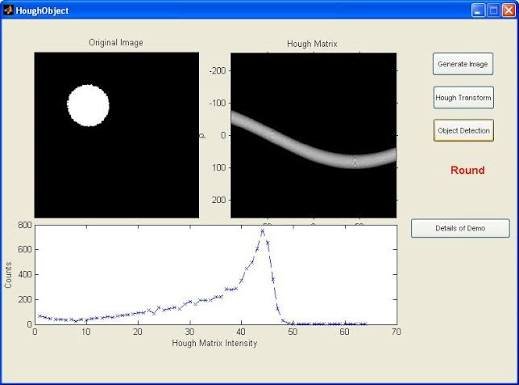
Computer vision systems need to accurately and efficiently identify shapes in images. One of the most reliable mathematical techniques for this task is the Hough Transform. Originally developed by Paul Hough in 1962 and later refined for general use, this method enables algorithms to detect geometric shapes such as lines, circles, and ellipses, even when they are partially obscured or noisy. Understanding how the Hough Transform works gives anyone studying image processing a solid foundation in the mathematics behind modern computer vision.
What Is the Hough Transform?
The Hough Transform is a feature extraction technique used in image analysis to detect shapes that can be described mathematically. Its core idea is to convert a shape-detection problem in image space into a peak-detection problem in a different space called the parameter space or accumulator space.
For a straight line, we know the equation is y = mx + c, where m is the slope and c is the intercept. However, representing lines in slope-intercept form becomes problematic when a line is vertical, since the slope is undefined. To fix this, the Hough Transform uses the normal parameterisation: r = x cos(theta) + y sin(theta), where r is the perpendicular distance from the origin to the line, and theta is the angle that the perpendicular makes with the horizontal axis.
For every edge pixel in a binary image, the algorithm plots a sinusoidal curve in the (r, theta) parameter space. Wherever multiple curves intersect, a line is detected. The intersection point directly reveals the parameters of that line.
Detecting Lines Step by Step
The process of detecting lines using the Hough Transform follows a clear sequence. First, edge detection is applied to the image, typically using an operator like Canny, to isolate boundary pixels. Next, an accumulator array is initialised, with axes representing the parameters r and theta.
For each edge pixel with coordinates (x, y), values of theta are iterated from 0 to 180 degrees, and the corresponding r value is calculated. The accumulator cell at position (r, theta) is incremented by one. After processing all edge pixels, the algorithm looks for local maxima in the accumulator, which represent the most prominent lines in the image.
This voting mechanism makes the Hough Transform remarkably robust. Even if part of a line is missing or broken due to noise, the surviving pixels still vote for the correct parameters.
Extending the Concept to Circle Detection
The Circular Hough Transform generalises the same idea for detecting circles. A circle is described by three parameters: the centre coordinates (a, b) and the radius r, following the equation (x – a)^2 + (y – b)^2 = r^2.
The accumulator for circle detection is three-dimensional, with one axis for each parameter. For each edge pixel and each candidate radius value, the algorithm increments all accumulator cells corresponding to circles passing through that pixel. Peaks in this 3D accumulator identify detected circles.
Because a full 3D search is computationally expensive, a common optimisation uses gradient information from the edge detector. Each edge pixel casts votes only along the direction of its local gradient, significantly reducing the search space and speeding up detection.
Practical Applications and Relevance
The Hough Transform has practical applications across many industries. In medical imaging, it helps detect circular structures such as cells or tumours. In manufacturing, it assists quality control by identifying edges and circular components in product images. In autonomous vehicles, it supports lane detection by finding straight lines on roads.
For anyone learning artificial intelligence and computer vision, grasping the Hough Transform is an important step. Students enrolling in an artificial intelligence course Delhi often encounter this algorithm early in their computer vision curriculum, as it bridges basic linear algebra with real-world image processing tasks.
The method’s mathematical elegance lies in how it converts a difficult global search problem into a straightforward local peak-finding problem. This makes it both analytically satisfying and practically efficient.
Conclusion
The Hough Transform remains a foundational tool in computer vision despite being introduced decades ago. Its ability to detect lines, circles, and other geometric shapes through parameter space voting makes it dependable across noisy and incomplete images. The technique connects cleanly to broader mathematical concepts such as parametric representation and accumulation methods.
Whether you are studying image processing independently or through a structured artificial intelligence course Delhi, understanding the Hough Transform equips you with a powerful tool for shape detection tasks. As computer vision continues to grow in importance, mathematical methods like this one remain as relevant as ever.
