
People new to textile processing often ask whether a lab carding machine is just a smaller industrial card. The answer is partly yes, since both use the same basic principle. But their purpose, design, cost, and use are quite different. This article explains the key differences so you can decide which is right for your needs.
The Shared Principle
Both machines open fibers, remove impurities, align the fibers, and deliver a web or sliver. Both use a rotating cylinder with fine wire teeth that works against other rollers or flats. The fundamental carding action is the same. The differences come from scale and purpose.
Difference 1: Production Capacity
An industrial carding machine is built for continuous output. It can process large quantities of fiber every hour for spinning mills or nonwoven lines. A lab carding machine handles small batches, often just grams to a few hundred grams per run. It is not designed to feed a production line.
Difference 2: Main Purpose
Industrial carding exists to produce material for sale or further manufacturing. Lab carding exists to gather information: fiber quality, blend behavior, web uniformity, and process settings. A lab machine’s output is a test sample, not a commercial product.
Difference 3: Size and Space
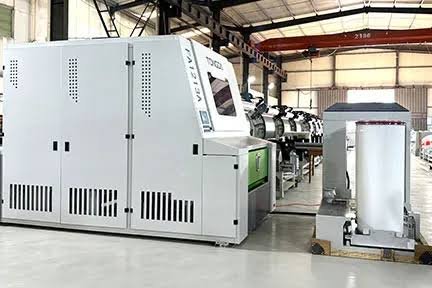
Industrial cards are large and heavy. They need dedicated floor space, strong foundations, material handling systems, and often dust extraction. A lab carding machine is compact and can often be installed in a testing room or laboratory.
Difference 4: Cost
Industrial machines require a large capital investment, plus installation, operators, and ongoing power and maintenance. A lab carding machine costs far less. For companies that only need testing capability, buying a production card would be unnecessary.
Difference 5: Flexibility for Experiments
Changing fibers or settings on a production card means stopping the line, cleaning, readjusting, and wasting material. A lab machine is easier to clean and reset, so you can try many fibers or conditions in a short time. This makes it ideal for experiments.
Difference 6: Material Requirement
To run a production card stably, you need a significant fiber quantity. For a new or costly fiber, this may be impractical. A lab machine works with small amounts, so you can evaluate material before buying in bulk.
Difference 7: Level of Automation
Industrial machines often include automatic feeding, auto-levelling, and monitoring systems designed for continuous operation. Lab machines are generally simpler and more manual, because the focus is on controlled, small-scale testing and observation.
Difference 8: Operators and Skills
Production cards need trained operators and maintenance staff. Lab machines are easier to operate, though correct technique still matters. This is one reason they are popular in teaching institutions.
Quick Comparison
| Feature | Lab Carding Machine | Industrial Carding Machine |
| Purpose | Testing, research, training | Mass production |
| Batch size | Small samples | Large continuous volume |
| Space needed | Compact | Large footprint |
| Cost | Lower | Much higher |
| Changeover | Quick | Slow |
| Best for | R&D, QC, education | Mills and factories |
Which One Do You Need?
Choose an industrial carding machine if you are running a spinning mill or nonwoven plant and need continuous output.
Choose a lab carding machine if you need to test fibers, develop new blends, compare suppliers, train staff, or prepare small samples.
Use both if you run production but want to avoid trial and error on the main line. Many mills test on a lab machine first and then move proven settings to the production card.
Can Lab Results Predict Production Results?
Lab carding gives very useful guidance, but it does not copy production behavior perfectly. Differences in speed, size, and feeding mean that settings and results may need adjusting when scaling up. Still, trends are reliable: a fiber that cards poorly in the lab will likely cause problems in production. Likewise, a fiber that cleans well and forms an even web in the lab is a good candidate for scale-up.
Getting Started with a Lab Unit
If your goal is sampling and testing, a lab unit is the logical choice. You can explore a lab carding machine and compare its listed features with your testing requirements.
Conclusion
Lab and industrial carding machines share the same core idea but serve different roles. The industrial machine produces; the lab machine informs. If your work involves testing, development, or education, a lab carding machine gives you the insight you need without the cost and complexity of production equipment.
