
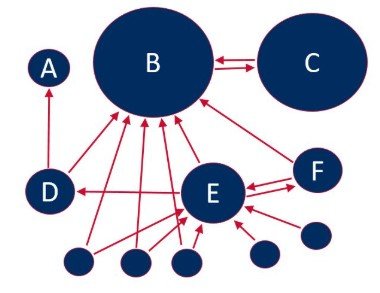
In network analysis not every node is of equal influence. Some nodes are essentially major hubs that draw in a lot of attention, connections and activity from all over the network. PageRank Centrality Score is the measure of that influence, looking at the incoming links. It’s not just a simple count of the number of links to a node. PageRank also takes into account the quality of the links. A link from an important node is going to be worth more than a link from a less important node.
This was a concept that became very well known through the use of search engines (where pages were ranked by the number of links they received from other pages). The same principle has been applied in a variety of other areas over the years including social networks, citation networks, recommendation systems and business intelligence. It’s a very useful concept for someone doing a data science course in Kolkata as it brings together graph theory, probability and practical analytics in a very accessible way.
Understanding the Basic Idea of PageRank
PageRank works on the simple principle that a node is important if it is linked to by other important nodes. It’s a recursive system in that a node doesn’t just become important because it has a lot of incoming links, it becomes important because it is linked to by important nodes.
Imagine a network of websites. A page gains value if a number of unknown sites link to it. The value of that link is very different if it comes from a highly reputable and well-linked site rather than from a number of obscure sites. That’s why PageRank is quite different from simple degree centrality (which just counts the number of incoming links).
The model also assumes that influence flows through the network. If an important node has links out to a number of other nodes then it passes on some of its value to them. PageRank therefore captures both direct and indirect importance across the network.
How the PageRank Centrality Score Is Calculated
At a conceptual level it’s an iterative process. Every node starts off with some initial score. Then in successive iterations each node passes its score on to the nodes that it points to. A node’s new score is determined by the amount of score it receives from other nodes.
A key part of the formula is the damping factor (typically set at around 0.85). This represents the notion that when a user is browsing the web they will most of the time simply follow a link, but at times will also jump randomly to a different node. This stops the algorithm getting stuck in a loop or a cluster of nodes that are all pointing to each other.
The process can be explained in three steps:
Initial assignment
Each node is given an equal starting score.
Score distribution
A node passes on part of its score to the nodes that it is connected to, split across its outgoing links.
Repeated updating
The scores get updated again and again until they stabilise and don’t change much from one iteration to the next.
This is obviously the method that makes PageRank so useful for large connected systems where it’s not at all obvious what the important pages are simply from counting.
Why Incoming Links Matter More Than Simple Counts
In many real world networks raw counts are misleading. A node can be receiving loads of incoming links from weak or inactive nodes and still not be very influential at all. Conversely a node with a relatively small number of incoming links from highly influential nodes may be of considerable strategic value.
Think about a citation network in research. A paper cited by ten papers that are themselves fairly obscure might be seen as quite popular. A paper cited by two really significant, highly respected papers on the other hand may in fact be far more influential in the field. PageRank is the better measure of this.
The same applies in the social media world, in business networks and in fraud detection. In a social network you’d probably rate a user who’s been followed by a number of highly connected experts as more important than one who’s been followed by a large number of fairly disconnected accounts. In the financial world you’d probably consider a transaction node which is connected to a number of trusted hubs to be more important than one which is connected to a number of untrusted nodes.
This is one of the reasons why PageRank is still so relevant in the world of analytics. A lot of the students in the data science course in Kolkata will come across such network problems where it’s not just the volume that matters, it’s the influence.
Practical Applications of PageRank in Data Science
PageRank is used all over the place beyond web search. It’s a key tool in data science for revealing structure in connected data.
Social network analysis
It identifies influential users, opinion leaders or communities based on the flow of importance through the connections.
Recommendation systems
It can rank products, users or content by looking at the interactions and relational patterns within a network.
Citation and knowledge graphs
It helps to identify the most influential papers, authors or concepts within a corpus of academic or technical data.
Fraud and anomaly detection
It can highlight suspicious nodes which acquire significance via rather odd but very strong network relationships.
Transportation and logistics
It can rank stations, hubs or routes by assessing how central they are in a travel or supply chain network.
These apps are a perfect example of why PageRank isn’t just a theoretical construct but a genuine analytical tool. If you’re doing any kind of graph analytics as part of a data science course in Kolkata you’ll find it extremely useful to understand how PageRank actually works to turn network structure into a notion of importance.
Limitations and Things to Watch
PageRank is of course very powerful but it’s by no means perfect. It’s very much dependent on the structure of the network and the direction of the links. If the input data is incomplete or noisy the results won’t necessarily be a good reflection of importance. In some cases it will also tend to favour the older, more established nodes in the system and it can be very difficult for new nodes to get any exposure at all.
Another issue is interpretability. A high PageRank score simply indicates that the node is structurally important, it doesn’t tell you why. You therefore need to use it in conjunction with other centrality measures (degree, betweenness and closeness) to get a fuller picture.
Conclusion
PageRank Centrality Score is a very useful way of measuring the importance of a node based on the number of links coming into it and the influence of the nodes that are linking to it. It’s much more than just a simple count and is a very good way of measuring the flow of authority/relevance through a network. It’s extremely useful in web analysis, social media analysis, research networks and innumerable business applications. For anyone getting into network analysis it’s a really good starting point in terms of understanding how a network can reveal information about influence and importance.
