
Introduction
The world of sports is full of exciting events that bring people together through competition, teamwork, and shared goals. Some sporting events focus primarily on winning, while others combine physical challenges with meaningful community support. Trideltathon is an interesting example of an event that brings these ideas together.
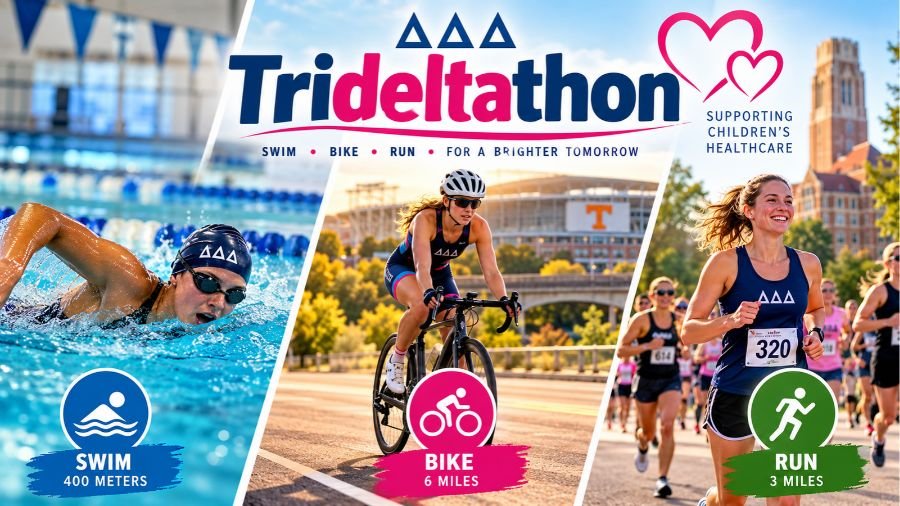
Associated with the University of Tennessee in Knoxville, Tennessee, Trideltathon is a charity-focused pool triathlon connected to the Delta Delta Delta sorority, commonly known as Tri Delta. The event combines three athletic disciplines: swimming, cycling, and running. It also has a charitable purpose, making participation about more than personal fitness or athletic achievement.
What makes Trideltathon particularly interesting is its combination of university traditions, community involvement, endurance sports, and fundraising. It provides an opportunity for athletes to challenge themselves while supporting a cause that benefits children and families.
Whether someone discovers the name through an interest in triathlons, university activities, or charitable events, understanding its background provides a clearer picture of why it has attracted attention. This article explores Trideltathon’s meaning, history, athletic format, charitable mission, preparation, and lasting significance.
What Is Trideltathon?
Trideltathon is a pool-based triathlon historically associated with the University of Tennessee in Knoxville. It brings together swimming, cycling, and running in one organized sporting event.
The name comes from the combination of Tri Delta and the word triathlon. Tri Delta is the familiar name for Delta Delta Delta, a national collegiate sorority with a history of community service and charitable activities.
Unlike a traditional triathlon that may begin in a lake or another open-water location, the historic Trideltathon uses a swimming pool for its opening discipline. This arrangement makes the swimming portion more approachable for participants who may feel uncomfortable with open-water competition.
The event has also been associated with individual competitors and relay teams. Individual participants complete all three stages themselves, while relay teams divide the disciplines among multiple members.
This flexible approach helps create an environment where people with different athletic abilities can participate. Experienced triathletes can test their endurance, while newcomers can experience multisport competition in a more manageable setting.
Another important feature is its charitable purpose. The event has historically supported East Tennessee Children’s Hospital, connecting athletic participation with community fundraising.
The Meaning Behind the Name Trideltathon
The name Trideltathon is distinctive because it reflects the organization and sporting activity behind the event.
The first part, Tri Delta, refers to Delta Delta Delta. The organization is commonly recognized by its shortened name among university students, alumni, and members of the wider Greek-letter community.
The second part, related to the word triathlon, represents the three athletic disciplines that form the competition.
Together, these elements create a recognizable name that communicates both the event’s identity and its connection to the sorority.
The naming approach also gives the event a community identity. Rather than using a generic sporting title, Trideltathon reflects the organization that helps support and organize the activity.
For people unfamiliar with American university traditions, understanding the connection between sororities and charitable events is useful. Many collegiate organizations arrange fundraising activities, volunteer programs, and community initiatives throughout the academic year.
Trideltathon is an example of how a university organization can use an athletic challenge to encourage participation and raise support for an important cause.
The History and Background of Trideltathon
Trideltathon has a long history connected to the University of Tennessee and the Knoxville community. Its beginnings are generally traced to the 1980s, when members of Delta Delta Delta helped establish the event as a fundraising activity.
Historical race listings identify the 2020 edition as the 36th year of the competition. This suggests that the event began around the middle of the 1980s, although the exact founding date should be distinguished from dates calculated using later edition numbers.
The original concept was relatively simple: organize a sporting competition that could bring athletes, students, volunteers, and community supporters together while raising money for children in need.
Over the years, the event developed an identity of its own. It became associated with local endurance athletes and the university community, offering an opportunity for participants to experience a triathlon without entering a particularly long-distance competition.
The event also experienced interruptions. In 2020, the University of Tennessee’s move to remote learning during the COVID-19 pandemic affected the planned competition. Organizers ultimately canceled that edition after attempts to find another suitable date.
Despite these challenges, historical records demonstrate the event’s importance as a longstanding example of university-based athletic fundraising.
Understanding the Three Stages of Trideltathon
The most recognizable feature of Trideltathon is its combination of swimming, cycling, and running. Each discipline requires different physical abilities, making the competition an interesting test of overall fitness.
Swimming is the first stage of the traditional Trideltathon format. Historical race information describes a pool swim of approximately 400 meters.
Unlike open-water swimming, a pool provides controlled conditions. Participants do not need to deal with waves, currents, or changing water conditions.
However, swimming still requires technique, breathing control, and endurance. Athletes must manage their energy carefully because the competition continues after they leave the pool.
For beginners, regular swimming practice can help improve confidence and efficiency. Learning to maintain a comfortable rhythm is often more useful than trying to swim as quickly as possible.
Cycling is the second discipline. Historical descriptions of Trideltathon identify a bike course of approximately six miles.
This section tests cardiovascular endurance, leg strength, balance, and the ability to maintain a consistent pace.
Cycling also introduces a different challenge because athletes must transition from swimming to riding a bicycle. Their bodies need to adjust from using the upper body extensively in the water to relying more heavily on the legs.
Participants should use a properly maintained bicycle and suitable safety equipment. Checking the brakes, tires, gears, and helmet before race day can help prevent unnecessary problems.
The goal is not simply to ride quickly. Maintaining control and managing energy are equally important.
Running is the final stage of the traditional competition. Historical course descriptions list a distance of approximately three miles.
This section can be especially challenging because participants have already completed swimming and cycling. Their legs may feel tired, and maintaining a steady running rhythm requires concentration.
A good running strategy involves starting at a manageable pace rather than using all available energy immediately.
Participants should also pay attention to hydration, comfortable footwear, and appropriate preparation.
Completing the running stage represents the final achievement of the traditional Trideltathon format. Crossing the finish line is a rewarding moment because it reflects the combined effort required across all three disciplines.
The Charitable Mission Behind Trideltathon
One of the most meaningful aspects of Trideltathon is its connection to charitable fundraising.
Historical event information identifies East Tennessee Children’s Hospital as a beneficiary. The hospital provides healthcare services for children and supports families dealing with a variety of medical needs.
By connecting a sporting competition with charitable fundraising, the event creates an opportunity for participants to contribute to something beyond their individual athletic goals.
This approach also encourages people who are not professional athletes to become involved. Students can volunteer, friends can support competitors, and community members can participate in fundraising activities.
The charitable purpose gives the competition a broader meaning. Every participant contributes to an atmosphere in which physical activity and community responsibility work together.
It is important to distinguish this local fundraising event from Tri Delta’s wider national philanthropic activities. Although the sorority has broader charitable partnerships, the historic Knoxville Trideltathon has been associated with East Tennessee Children’s Hospital.
Who Organizes Trideltathon?
Delta Delta Delta, commonly called Tri Delta, has played an important role in the event’s organization and volunteer support.
The sorority is a collegiate organization that encourages friendship, leadership, personal development, and community involvement. Its members participate in activities that bring students together and provide opportunities to support charitable causes.
The Knoxville triathlon has also been associated with the local multisport community, including the Greater Knoxville Triathlon Club.
This combination of university volunteers and experienced sporting participants helps create an event that serves different groups.
Volunteers can assist with event preparation, registration, participant guidance, and general organization. Athletic organizations contribute knowledge about race procedures and the practical requirements of a multisport competition.
The result is a collaborative activity that depends on more than the athletes competing on the course.
Why Trideltathon Is Different From a Traditional Triathlon
Although Trideltathon follows the basic structure of a triathlon, several features distinguish its historic format from many larger competitions.
First, its swimming stage takes place in a pool rather than open water. This makes the opening discipline easier to manage for participants who are new to multisport racing.
Second, the distances are relatively short. A 400-meter swim, six-mile bicycle ride, and three-mile run provide a meaningful challenge without requiring the extensive preparation associated with longer-distance triathlons.
Third, the event has a strong university and charitable identity. Its purpose is not limited to identifying the fastest competitors.
Finally, relay participation creates additional opportunities for teamwork. Instead of requiring every participant to complete all three disciplines, relay teams can divide the challenge according to individual strengths.
These characteristics help explain why the event has historically appealed to both experienced athletes and people interested in trying a triathlon for the first time.
How to Prepare for Trideltathon
Preparing for a triathlon requires consistency, patience, and a balanced training routine. Even though the historic Trideltathon format is shorter than many other triathlons, participants still need to prepare for three different physical activities.
Here are some useful preparation strategies.
Develop a Swimming Routine
Swimming practice should focus on technique, breathing, and endurance. Beginners can start with shorter distances and gradually increase their training volume.
Practicing in a pool similar to the competition environment can also help participants become more comfortable with the swimming stage.
Improve Cycling Endurance
Cycling regularly helps build leg strength and cardiovascular fitness. Participants should practice maintaining a steady speed rather than focusing exclusively on maximum performance.
A few short rides each week can help develop confidence and improve bicycle handling.
Build Running Stamina
Running preparation should begin at a comfortable level. People who are new to running can combine walking and jogging before gradually increasing their running distance.
Consistency is more important than completing every training session at a high intensity.
Practice Transitions
Transitions are an important part of multisport competition. Participants need to move efficiently between swimming, cycling, and running.
Practicing how to organize equipment, change footwear, and prepare for each stage can make race day less stressful.
Maintain Proper Nutrition and Hydration
Balanced nutrition supports training and recovery. Participants should eat regular meals, drink enough water, and avoid experimenting with unfamiliar foods immediately before competition.
Anyone with particular dietary or medical requirements should consider appropriate professional advice when developing a training plan.
Individual Participation and Relay Teams
Another interesting feature of Trideltathon is the opportunity for different participation styles.
Individual competitors complete all three stages themselves. This format provides a complete personal endurance challenge and allows athletes to measure their overall performance.
Relay teams divide the three disciplines among multiple participants. For example, one person may complete the swimming stage, another may handle cycling, and a third may finish the running section.
Relay participation makes the competition more accessible to people who are confident in one particular sport but less experienced in the others.
It also encourages teamwork. Each team member has a responsibility, and the overall result depends on everyone completing their assigned section.
For university students, this format can be an enjoyable way to participate in a sporting activity with friends.
The Difference Between Trideltathon and TriDeltaRUN
People searching for Trideltathon may also encounter information about TriDeltaRUN. Although the names are related, the two formats should not automatically be treated as identical.
The historic Trideltathon is associated with swimming, cycling, and running. TriDeltaRUN, on the other hand, is a running-focused event that has continued the broader community and fundraising tradition in Knoxville.
The distinction matters because historical triathlon distances should not be assumed to apply to a modern running event.
Anyone interested in participating should check the specific edition’s announcement, registration information, and organizer instructions.
Likewise, an old registration listing does not establish that a new Trideltathon competition is currently scheduled.
Why Trideltathon Matters to the Community
Trideltathon represents an interesting connection between athletics, education, volunteering, and charitable responsibility.
University communities often provide opportunities for students to develop leadership skills outside traditional classrooms. Organizing a sporting event requires planning, cooperation, communication, and the ability to work toward a common objective.
Events like Trideltathon demonstrate how these skills can be used in practical situations.
The competition also brings together people with different backgrounds. Experienced athletes can share their knowledge, beginners can discover new interests, and volunteers can contribute without needing to compete.
Its charitable purpose adds another important dimension. Supporting children’s healthcare gives the event a community benefit that extends beyond the finish line.
This combination of activities helps explain why locally organized sporting traditions can remain meaningful for many years.
The Future of Trideltathon
The future of Trideltathon depends on the organizers, university community, charitable partners, and local sporting organizations.
One possible way to preserve its legacy is through continued involvement from students and volunteers. University organizations regularly experience membership changes, so passing responsibilities between generations is important for maintaining long-running activities.
Modern event management also creates opportunities to improve communication, registration, participant safety, and fundraising.
Digital registration systems can make participation easier, while social media can help organizers reach people who may not already be connected to university athletics.
However, preserving the event’s original identity is equally important. Its distinctive combination of swimming, cycling, running, and charitable involvement is what makes it recognizable.
As of November 2026, historical information establishes the event’s previous existence, but a newly dated official announcement should be checked before assuming that another edition is scheduled.
Frequently Asked Questions About Trideltathon
1. What is Trideltathon?
Trideltathon is a historic charity pool triathlon associated with Delta Delta Delta at the University of Tennessee in Knoxville. It combines swimming, cycling, and running.
2. Where was Trideltathon held?
The historic competition was associated with the University of Tennessee in Knoxville, Tennessee, using the university’s aquatic facilities and surrounding campus area.
3. What are the traditional Trideltathon distances?
Historical event information describes approximately 400 meters of swimming, six miles of cycling, and three miles of running.
4. Who organizes Trideltathon?
The event has been associated with the University of Tennessee’s Delta Delta Delta sorority chapter and members of the local Knoxville triathlon community.
5. What is the charitable purpose of Trideltathon?
Historical editions supported East Tennessee Children’s Hospital, connecting athletic participation with fundraising for children’s healthcare.
6. Can beginners participate in Trideltathon?
The historic short-distance format and relay option made the event approachable for people with different athletic backgrounds. However, participants should check the requirements of the specific edition.
7. Is Trideltathon an individual or team competition?
Historical registration information included both individual and relay divisions. Relay teams allow multiple participants to divide the three athletic disciplines.
8. Is Trideltathon still held every year?
Historical records document multiple editions, but that does not confirm a current annual schedule. Participants should look for a newly dated announcement from the organizers.
9. How is Trideltathon different from a regular triathlon?
Its historic format uses a pool swim and relatively short cycling and running distances. It also has a distinctive university-based charitable mission.
10. What makes Trideltathon special?
Its combination of endurance sports, university traditions, volunteer participation, and charitable fundraising makes it different from competitions focused exclusively on athletic results.
Conclusion
Trideltathon is an interesting example of how sports can bring communities together while supporting meaningful charitable causes. Its association with Delta Delta Delta and the University of Tennessee gives it a distinctive identity within Knoxville’s sporting history.
The traditional combination of a 400-meter swim, six-mile cycling course, and three-mile run offers a manageable but rewarding endurance challenge. Its individual and relay formats have also provided opportunities for participants with different abilities and experience levels.
Beyond the athletic competition, its connection to East Tennessee Children’s Hospital highlights the importance of community fundraising and volunteer involvement.
Ultimately, Trideltathon represents more than a sporting event. It reflects teamwork, determination, university spirit, and the positive impact that organized community activities can have. Its historical legacy demonstrates how a relatively simple athletic challenge can develop into a meaningful tradition that connects people through fitness and charitable service.
