
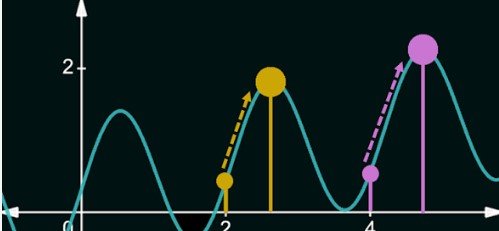
Optimisation is a fundamental problem in computer science and AI. Given a problem with many possible solutions, how do you determine which is best? Hill climbing is one of the most obvious answers to that. It’s a search algorithm which simply keeps moving in the direction of better values until it gets to a point where there’s no better neighbour. It’s a very simple algorithm to understand, but it’s absolutely fundamental to anyone who’s got any real expertise in AI and search.
What Is Hill Climbing?
Hill climbing is a heuristic search algorithm used in optimisation. The name is self-explanatory, really: imagine you’re standing on a hillside in total fog and your objective is to get to the top. You can’t see the landscape, so your only option is to take one step at a time in the direction that takes you uphill. You keep going until you can’t go any further in any direction, as that’s when you’ve reached a peak.
In computational terms, the ‘landscape’ is the solution space and the ‘altitude’ is the quality of a solution (usually measured by some objective function). The algorithm looks at the neighbours of a state and moves to the one with the highest value. It does this iteratively until a local optimum is reached.
Hill climbing is part of a wider family of local search algorithms. It’s very much in the same family as the stuff you’d be taught in any artificial intelligence course in chennai or indeed anywhere else (greedy search, gradient ascent, etc).
Types of Hill Climbing
There are several variants of the algorithm, each suited to different problem characteristics:
Simple Hill Climbing evaluates one neighbouring state at a time and moves to that state if it is an improvement. It’s very cheap to compute but can potentially miss out on a whole host of better alternatives that are in the neighbourhood.
Steepest-ascent hill climbing looks at all the neighbouring states before it makes a move and always picks the neighbour which gives the greatest improvement. That’s a more exhaustive approach, but it’s going to be more computationally expensive per step.
Stochastic Hill Climbing introduces randomness by selecting a neighbour at random from amongst the improving ones. This variant reduces the chance of getting stuck early and can be quite useful in some solution spaces.
Random-Restart Hill Climbing deals with one of the algorithm’s fundamental flaws by running the basic algorithm many times from different random starting points. The best solution found across all of the runs is then selected as the final answer.
Core Challenges: Local Optima, Plateaus, and Ridges
Despite its simplicity, hill climbing has well-known limitations which practitioners must be aware of.
Local optima are the big problem. It stops as soon as it gets to a peak, but that peak may not be the global maximum at all. It may just be the highest point in the local neighbourhood. There’s no way for the algorithm to go any further than that.
Plateaus are flat regions in the solution space where all the neighbouring states have the same value. There’s no gradient to follow, and the algorithm can get stuck and make no progress at all.
Ridges are narrow, elevated paths in the solution space which are very hard to get across if the neighbouring states in most directions are a descent. The algorithm can fail to follow the ridge properly with standard step sizes.
These are not reasons to throw hill climbing away. They’re reasons to use it with care. An understanding of these failure modes is a fundamental topic in any good artificial intelligence course in chennai and is absolutely essential if you’re going to be able to pick the right algorithm for the job.
Practical Applications of Hill Climbing
Hill climbing is used across a wide range of real-world applications:
Scheduling problems (assigning tasks, shifts or resources to minimise conflict or otherwise achieve some form of efficiency) are a very natural fit for local search.
Route optimisation: in logistics terms, hill climbing will work by swapping one stop for another and checking whether the total distance is reduced.
Neural network training: gradient descent (the very backbone of modern deep learning) is a form of continuous hill climbing based on calculus, which tunes the model parameters to reduce prediction error.
Game AI: Hill climbing enables game agents to make a series of incremental decisions that will improve their position, their score or their strategic position over time.
It’s so versatile across the board that it’s a genuinely useful algorithm rather than just a toy.
Conclusion
Hill climbing is a very elegant and effective optimisation technique. You’re always moving in the direction of higher value states, and so you’re very quickly going to find a local peak. The only real downside is that you can get stuck in a local optimum, and that can be dealt with in a number of ways (random restarts, stochastic selection, etc.). For students and professionals in the course on search and optimisation via AI in Chennai it’s a very good technique to have in your toolbox, as it’s both a very sound concept and a technique that can be used in practice for a whole range of problems.
