
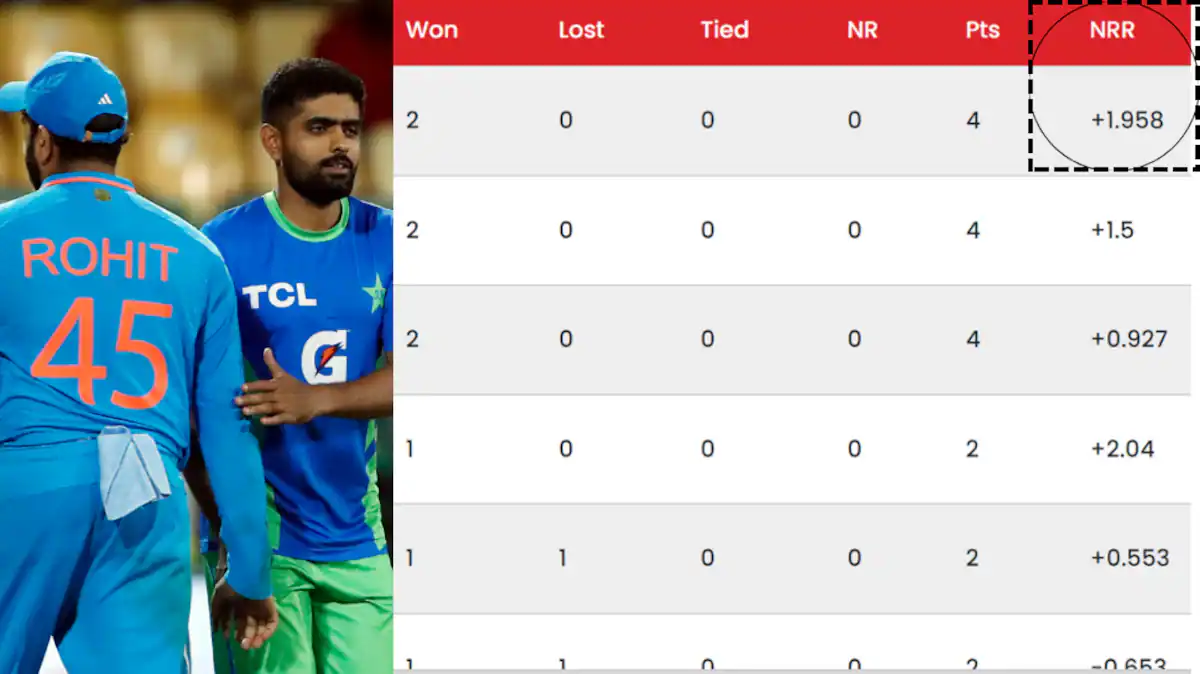
Net run rate (NRR) measures how quickly a team scores compared with how quickly it concedes runs across a limited-overs tournament. It is commonly used to separate teams that finish level on points in a league table. A positive NRR means a side has scored faster overall than its opponents; a negative figure means opponents have scored faster against it.
The net run rate formula
The basic formula is straightforward:
Net Run Rate = (total runs scored ÷ total overs faced) − (total runs conceded ÷ total overs bowled)
The first part of the calculation is the team’s scoring rate. The second is the scoring rate it has allowed opponents. Subtract the latter from the former to get NRR.
For example, suppose a team has scored 600 runs from 100 overs during a competition. Its scoring rate is 6.00 runs per over. If it has conceded 550 runs from 100 overs, the opposition scoring rate is 5.50. Its NRR would be:
6.00 − 5.50 = +0.500
The sign matters. A plus sign indicates a favourable rate difference, while a minus sign indicates that the team has been outscored per over across its completed matches.
Why NRR matters in tournament tables
In multi-team limited-overs competitions, teams often finish with the same number of points. Tournament regulations determine the precise order of tie-breakers, but NRR is widely used because it captures both batting speed and bowling control over a series of games.
It is not simply a record of wins and losses. A team can win a close match and make little NRR progress, while a large victory can produce a substantial improvement. Equally, a heavy defeat can damage a side’s NRR even if it remains competitive on points.
For readers following scorecards, standings and phrases such as today match prediction 100 sure, understanding NRR helps explain why teams sometimes focus on the speed of a chase or the margin of victory, not only the result itself.
Calculate totals across the tournament, not match by match
A common mistake is to add together, or average, NRR figures from individual matches. That is not how tournament NRR is generally calculated.
Instead, add all runs scored and all overs faced across the relevant completed matches. Then separately add all runs conceded and all overs bowled. Only after calculating the two aggregate run rates should the subtraction be made.
According to ESPNcricinfo’s explanation of the method, South Africa’s NRR after three matches in the 1999 World Cup was calculated from 678 runs in 147 overs and two balls, and 466 runs conceded from 150 overs. In decimal form, 147 overs and two balls equals 147.333 overs.
| Component | Calculation | Result |
| Run rate scored | 678 ÷ 147.333 | 4.602 |
| Run rate conceded | 466 ÷ 150 | 3.107 |
| Net run rate | 4.602 − 3.107 | +1.495 |
This approach means longer innings carry more weight than shorter ones. A fast chase completed early can have a major effect because the winning side scores its runs in fewer overs.
Cricket overs are not decimal numbers
One of the easiest calculation errors comes from reading overs incorrectly. In cricket notation, 19.3 overs does not mean 19.3 overs in a mathematical decimal sense. It means 19 overs and three balls.
Because an over has six legal balls:
- 19.1 overs = 19 + 1/6 overs
- 19.2 overs = 19 + 2/6 overs
- 19.3 overs = 19.5 overs
- 19.4 overs = 19.667 overs
- 19.5 overs = 19.833 overs
For instance, 254 runs from 46.3 overs means 254 runs from 46.5 overs, not from 46.3 overs. The run rate is therefore calculated as 254 ÷ 46.5.
This distinction is especially important in T20 cricket, where a few balls can significantly alter a chase rate and, consequently, a team’s NRR.
What happens when a team is bowled out?
The full-quota rule is one of the most important parts of NRR calculation. If a team is dismissed before using all of its allotted overs, its innings is treated as having used the full quota for NRR purposes.
In a 50-over match, a side all out in 42 overs is still considered to have faced 50 overs when calculating NRR. In a 20-over match, a side bowled out in 16 overs is treated as having faced 20 overs.
Consider this 50-over example:
- Team A scores 251 for 8 in 50 overs.
- Team B is all out for 230 in 42 overs.
For NRR, Team B’s score is counted as 230 from 50 overs, not 42. Team A’s match NRR is:
251 ÷ 50 − 230 ÷ 50 = +0.420
Without the full-quota rule, the dismissed team could appear to have scored at a better rate merely because it was bowled out early. The rule prevents that distorted outcome.
How a successful chase affects NRR
A team that reaches a target while retaining wickets is not all out, so its actual overs faced are used. This is why quick chases can greatly improve NRR.
Take another 50-over example:
- Team A makes 251 for 8 from 50 overs.
- Team B reaches 254 for 9 from 46.3 overs.
Since 46.3 overs is 46.5 overs mathematically, Team B’s scoring rate is 254 ÷ 46.5. Team A’s rate is 251 ÷ 50. The resulting match NRR for Team B is approximately:
254 ÷ 46.5 − 251 ÷ 50 = +0.442
The chasing team benefits because it crossed the target in fewer overs. It is not the wicket margin that drives this improvement; NRR focuses on runs and overs, not wickets lost.
Rain-affected and abandoned matches
Weather interruptions make NRR more complicated. ESPNcricinfo notes that only matches in which a result is achieved count towards NRR calculations. A match abandoned with no result does not contribute its runs or overs to the tournament calculation.
When a result is achieved through the Duckworth/Lewis method, the calculation uses adjusted values. If a match is abandoned but decided under Duckworth/Lewis, the team batting first is credited with the par score applicable to the overs faced by the second team. If a revised target has been applied and the match is completed, the first innings is credited with one run fewer than the final target, using the overs allocated to the chase.
These rules aim to make interrupted matches comparable, although the calculations can be less intuitive than those for a full-length game.
What NRR does not measure
NRR is useful, but it does not provide a complete verdict on a team’s quality. It ignores wickets lost, so it does not directly reflect how comfortable or difficult a win was.
A team may complete a chase with only one wicket left yet record a strong NRR if it gets there quickly. Conversely, a side may win comfortably in terms of wickets but improve its NRR less if the chase takes most of the innings.
NRR also cannot be treated as a prediction of what will happen in the next match. It is a summary of scoring rates in matches already played. Conditions, opposition strength, match situation and the length of innings can all influence it.
A practical way to check NRR
To work out a team’s tournament NRR accurately, keep four running totals: runs scored, overs faced, runs conceded and overs bowled. Apply the full-quota rule whenever a side is all out, convert balls into fractions of an over correctly, and exclude no-result matches.
NRR can look complicated because of special cases, but its central idea remains simple: score faster than opponents over the competition as a whole. Once the aggregate totals and full-quota rule are understood, points-table movements become much easier to follow.

Emily Claire is a dedicated writer and English grammar specialist who helps readers improve their language skills with clarity and confidence. At Grammar Schooling, she turns complex grammar rules into clear, engaging lessons that make learning enjoyable. Her passion lies in empowering learners worldwide to communicate effectively and express themselves with ease.