
Numbers have a way of exposing writing that is otherwise clean. A report can be well organized and carefully proofread, and then one sentence says “sales increased by 20 percent to 45 percent” and the reader has no idea what actually happened. Percentages are especially tricky because they sit at the point where grammar and arithmetic meet, and a small slip in either one changes the meaning.
This guide covers the questions that come up most often when writing about percentages: which word to use, whether the verb should be singular or plural, how to describe changes clearly, and a few phrases that are best avoided altogether.
Percent vs. percentage
These two words are related but not interchangeable.
Percent goes with a specific number. It means “out of a hundred,” and it always follows a figure: 15 percent, 3.5 percent, 100 percent.
- Only 12 percent of respondents disagreed.
Percentage is the general noun. You use it when you are talking about a proportion without giving the number, and it is usually paired with a word like large, small, high or what.
- A large percentage of respondents disagreed.
- What percentage of the budget goes to marketing?
So “a high percent of students” is wrong, and so is “12 percentage of respondents.” If there is a number, use percent. If there isn’t, use percentage.
Percent, per cent or %?
All three are correct. The choice depends on where you are writing and which style guide you follow.
American English writes percent as one word. British English has traditionally used per cent as two words, although percent is now common in the UK as well. Pick one and stick with it throughout a document.
The symbol is a matter of style. The Associated Press Stylebook, widely used by American news outlets, switched in 2019 to recommending the % sign with numerals in most cases, so you will see “a 5% rise” in many newspapers. Academic and book publishing has traditionally preferred the word in general prose, keeping the symbol for scientific, technical and statistical writing, tables and charts. If you are writing for a particular publication or school, its style guide settles the question.
Two rules hold almost everywhere. First, use numerals with percent, even for small numbers: 4 percent, not four percent. Second, do not start a sentence with a numeral. Either spell the number out or rearrange the sentence.
- Twenty percent of the staff work remotely.
- About 20 percent of the staff work remotely.
Singular or plural verb?
This is the question that trips up even experienced writers. Is it “40 percent of the class is absent” or “40 percent of the class are absent”?
The rule is simple once you see it: the verb agrees with the noun that follows “of.”
- Forty percent of the cake was eaten. (cake is singular)
- Forty percent of the guests were late. (guests is plural)
- Ten percent of the water is contaminated.
- Ten percent of the samples are contaminated.
When percentage stands alone, the article in front of it often decides. “The percentage” refers to a single figure and takes a singular verb. “A percentage of” followed by a plural noun usually takes a plural verb, because the focus is on the people or things.
- The percentage of students who passed has risen.
- A small percentage of students have complained.
Percent increase vs. percentage point increase
This is where grammar and math really collide, and it is one of the most common errors in news reports and business writing.
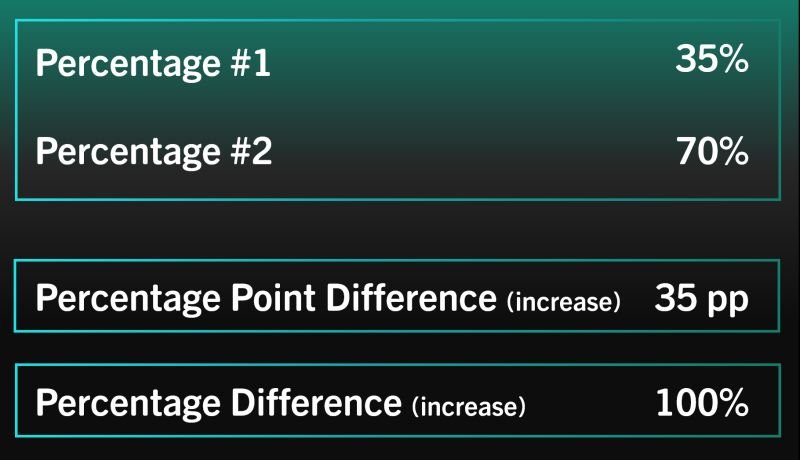
A percentage point is the simple difference between two percentages. A percent change is that difference measured relative to the starting value.
Say a company’s profit margin goes from 10 percent to 15 percent. That is:
- an increase of 5 percentage points, and
- an increase of 50 percent (because 5 is half of 10).
Both statements are accurate, but they describe the change in very different ways, and writing “the margin rose 5 percent” is simply wrong. When you are comparing two rates, interest rates, approval ratings, unemployment figures, test pass rates, use percentage points for the raw difference.
If you need the relative figure, take the difference between the new and old values, divide by the old value and multiply by 100. For anything that will be published, it is worth checking the figure with a Percentage Increase Calculator rather than doing it in your head, because the most common mistake is dividing by the new number instead of the original one. A wrong base produces a number that looks perfectly reasonable and is still incorrect.
“Rose by” vs. “rose to”
Small prepositions carry a lot of weight in sentences about numbers.
- Prices rose by 10 percent means the size of the change was 10 percent.
- Prices rose to $110 gives the new level.
- The pass rate rose from 60 percent to 72 percent gives both ends, which is usually the clearest option of all.
Problems start when writers combine them carelessly. “Unemployment increased by 5 percent to 7 percent” leaves the reader guessing whether the change was five points or five percent. Rewriting it as “unemployment rose from 5 percent to 7 percent” removes the ambiguity, and the reader can work out the change themselves.
Similarly, note the difference between “an increase in” and “an increase of.” You have an increase in something (an increase in costs) and an increase of an amount (an increase of 8 percent). Both can appear in the same sentence: an increase of 8 percent in costs.
Phrases to avoid
“Times more” and “times less.” “Three times more expensive” is used loosely to mean “three times as expensive,” but strictly speaking it could mean four times the price (the original plus three times more). “Times less” is even worse, because it is not clear what “three times less” of anything would be. Prefer “three times as much” or “a third of the price.”
“Over 100 percent” for things that cannot exceed it. A team can give 110 percent in a pep talk, but in factual writing, a share of a whole cannot go above 100 percent. Increases, on the other hand, can: if a price goes from $50 to $150, that is a 200 percent increase.
“Doubled by 100 percent.” Doubling already means a 100 percent increase. Say one or the other, not both.
Vague comparatives. “A significant percentage” or “a large percentage” tells the reader very little. If you know the number, give it.
A quick checklist before you hit publish
When a sentence contains a percentage, run through these questions:
- Is there a number? Then the word is percent, not percentage.
- Does the verb agree with the noun after “of”?
- Am I comparing two percentages? If so, do I mean percentage points or percent change?
- Have I used by, to and from precisely?
- Is the calculation itself correct, measured from the original value?
- Have I followed one style throughout, with the same spelling and the same choice of word or symbol?
Numbers make writing more persuasive, but only if readers trust them. A sentence that mixes up percent and percentage points, or pairs a plural subject with a singular verb, makes careful readers doubt everything around it. Getting these details right takes only a few seconds, and it is the difference between a figure that informs and one that confuses.
