
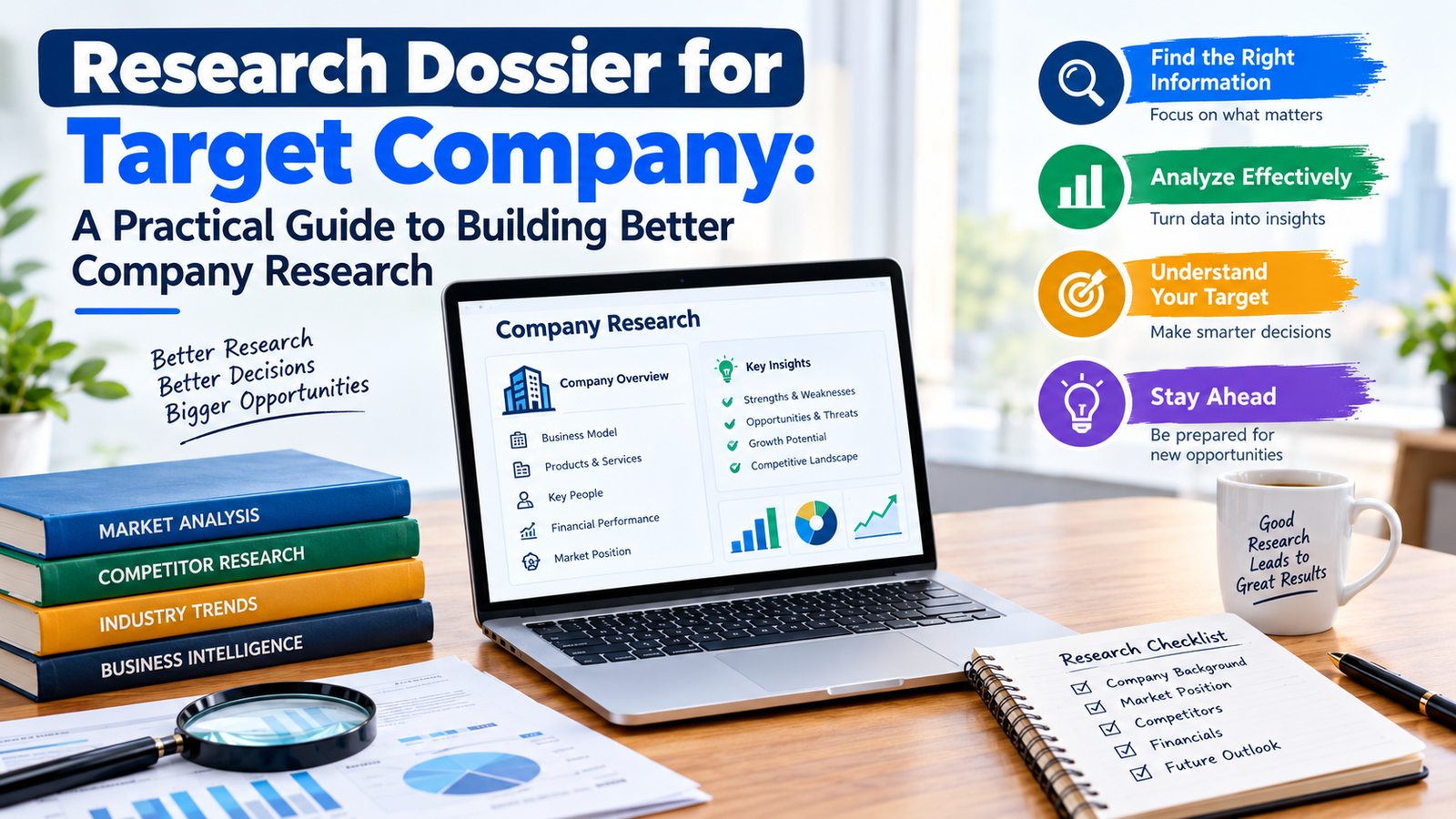
Researching a business can look easy at first. You search for the company name, open a few websites, read some articles, check its social profiles, and collect whatever information seems useful. The problem is that this approach often produces a pile of disconnected facts rather than a clear understanding of the company.
A research dossier for a target company provides a more organized way to solve that problem. Instead of collecting information randomly, a dossier brings important business details together in one structured document. It can include the company’s background, ownership, leadership Research Dossier for Target Company, products, business model, financial information, competitors, market position, risks, and supporting evidence.
This type of research can be useful for many different purposes. Sales teams may use it before approaching an important prospect. Researchers may need it for competitive intelligence. Investors can use company research to understand a business more thoroughly, while students, consultants, entrepreneurs, and business development professionals may use similar information for projects and strategic planning.
The most important point is that a good dossier is not simply long. It is useful because the information is relevant, organized, dated, and supported by evidence. The goal is to make it easier for someone to understand a company and answer specific research questions without going through dozens of disconnected sources.
What Is a Research Dossier for a Target Company?
A research dossier for a target company is a structured collection of information and evidence about a particular business. It is normally created to answer specific questions about the organization and provide a reliable foundation for further analysis.
The phrase “target company” does not necessarily refer to Target Corporation. In business research, a target company simply means the organization being investigated. It could be a startup, private company, public corporation, technology business, retailer, manufacturer, agency, healthcare organization, or potential business partner.
A basic company profile usually covers simple information such as the company’s name, headquarters, founding date, products, services, and leadership. A research dossier goes further by connecting those facts with business performance, ownership, competitors, customers, market conditions, risks, and strategic developments.
That additional context is what makes a dossier valuable. For example, knowing that a company has increased revenue is useful, but it does not tell the complete story. A stronger research document also considers the period involved, the source of the figure, changes in profitability, business segments, market conditions, and other information that could explain the result.
Why Is a Target Company Research Dossier Important?
One of the biggest benefits of a company research dossier is organization. Business information is usually spread across many different sources, including official websites, annual reports, regulatory databases, news publications, industry reports, career pages, interviews, and corporate announcements.
Without a structured process, it is easy to lose track of where information came from. You may remember a statistic but forget whether it came from an official filing or an outdated third-party website. A dossier solves this problem by keeping the information and its source together.
A well-prepared dossier can also save time. Once the important company information has been organized, a researcher does not need to repeat the same basic investigation every time the company is discussed. The document can become a reference point that is updated when important information changes.
Another benefit is better decision-making. The dossier itself does not make a business decision for the reader. Instead, it provides the evidence needed to ask better questions. Whether someone is considering a partnership, preparing a sales strategy, studying a competitor, or conducting general research, having organized information makes the next step easier.
Start With a Clear Research Objective
Before opening dozens of search results, define exactly why you are researching the company. This is one of the simplest ways to prevent unnecessary work.
For example, a sales professional may want to understand the company’s products, decision-makers, expansion plans, and business priorities. A competitive researcher may focus more heavily on products, pricing, market positioning, technology, customers, and competitors.
An investment-oriented project could require greater attention to financial performance, ownership, debt, business segments, management, risks, and strategic developments. Meanwhile, an academic project may require a broader historical and organizational overview.
Write the research objective at the beginning of the dossier. You can also create a short list of questions that the final document must answer. These questions become a research checklist and help prevent the project from turning into an endless collection of unrelated information.
For example, useful questions might include:
- Who owns the company?
- What products or services does it provide?
- Who are its main customers?
- How does the business make money?
- What markets does it serve?
- Who are its major competitors?
- What recent developments could affect the company?
- What risks should researchers understand?
- Which important claims can be independently verified?
Collect the Basic Company Information First
Every research dossier should establish the identity of the company before moving into deeper analysis. This may sound obvious, but businesses can have similar names, subsidiaries, brand names, and parent organizations.
Begin with the company’s official or legal name, commonly used brand name, website, headquarters, industry, founding year, ownership type, and geographic markets. If the business operates under a parent organization, record that relationship as well.
The official company website is normally a useful starting point. Pages such as About, Leadership, Products, Services, Investor Relations, Newsroom, Careers, and Corporate Governance can provide important first-party information.
However, company websites should not automatically be treated as neutral sources. Businesses naturally present their organizations and products in a favorable way. Corporate claims are therefore most useful when the important ones can be supported or cross-checked through independent evidence.
Identity verification is especially important when the company has a common name. A simple search for a name may produce several unrelated businesses. Adding the company’s official domain, location, industry, or legal name to research queries can reduce the risk of mixing information from different organizations.
Research the Company’s History and Development
A company’s history can reveal how its current business model developed. Instead of simply recording the founding year, look for meaningful milestones that changed the direction or scale of the organization.
Important events might include the launch of major products, acquisitions, mergers, expansion into new markets, leadership changes, rebranding, restructuring, major partnerships, or changes in ownership.
Historical information should be presented with dates whenever possible. This allows readers to understand the sequence of events instead of seeing a collection of disconnected milestones.
It is also useful to distinguish between what the company officially announced and what independent sources reported. An acquisition announcement, for example, can be confirmed through company statements, regulatory filings, or established business publications.
The goal is not to create a long biography. The goal is to understand how earlier decisions shaped the business that exists today.
Examine the Business Model
Understanding how a company makes money is one of the most important parts of a research dossier. A company can have an impressive product portfolio and strong brand recognition, but researchers still need to understand the commercial engine behind the organization.
Start by identifying what the company sells and who buys it. Determine whether revenue comes from products, subscriptions, advertising, licensing, services, marketplaces, commissions, physical locations, or a combination of several models.
Next, examine how the business reaches customers. Distribution channels, sales teams, online platforms, retail locations, partnerships, resellers, and direct-to-consumer operations can all influence the company’s economics.
The business model should also be connected to the company’s market. A subscription software company, for example, may depend heavily on customer retention and recurring revenue, while a manufacturer may be more affected by production costs, supply chains, inventory, and physical distribution.
A good dossier explains these relationships rather than simply saying what the company sells. That additional context makes the research much more useful.
Analyze Products, Services, and Customers
The next step is to create a clear picture of the company’s offerings. List its major products and services, but avoid turning the section into promotional copy.
For each major offering, consider what problem it solves, who uses it, how it is delivered, and how it fits into the company’s broader business model. If reliable public information is available, note important product launches, updates, or changes.
Customer research is equally important. Identify the company’s major customer groups and geographic markets where reliable information is available. Business customers and individual consumers can have very different purchasing behavior, so this distinction should be clear.
You should also consider customer concentration when reliable information exists. If a business depends heavily on a small number of customers, partners, platforms, or distribution channels, that dependency may be relevant to understanding its operations.
The objective is not to speculate about private customer information. Use publicly available evidence and clearly label information that is estimated, independently reported, or officially disclosed.
Research Leadership and Organizational Structure
Leadership can provide useful context about a company’s strategy and development. Start by identifying executives, founders, board members, or other senior personnel who are publicly documented.
Record relevant roles and dates rather than collecting biographies that have no connection to the research objective. For example, a leadership change may matter because it coincided with a major strategic shift.
Organizational structure can also help explain how a company operates. Larger businesses may have multiple divisions, subsidiaries, geographic regions, or business segments. Understanding those relationships can prevent researchers from treating the entire organization as one simple unit.
When researching private companies, public information may be more limited than it is for public corporations. In those cases, the dossier should clearly identify gaps instead of filling them with assumptions.
A strong research document is comfortable saying that information could not be verified. A missing fact is better than an invented one.
Review Financial and Business Performance
Financial research can be one of the most valuable sections of a company dossier, particularly for public companies. Depending on the organization, useful information may include revenue, operating income, net income, cash flow, debt, capital expenditure, business segments, and geographic performance.
Always record the relevant reporting period. Financial figures without dates can become misleading very quickly because company performance changes over time.
Public companies often provide annual reports and regulatory filings that offer detailed financial information. These documents are generally more useful for financial research than random websites that simply repeat numbers without explaining their source.
Do not look at revenue alone. Revenue growth can be accompanied by rising costs, changing margins, increased debt, or other developments. A useful dossier places financial numbers into context instead of presenting isolated statistics.
For private companies, detailed financial information may not be publicly available. In that situation, clearly identify the limitation. Estimates from reputable third-party sources can sometimes provide context, but they should never be presented as confirmed company figures.
Study Competitors and Market Position
Competitor analysis helps explain where the company sits within its broader industry. Start by identifying businesses that offer similar products or services to similar customers.
However, competitors should not be selected simply because they appear in a generic online list. A company may compete directly with one business while also facing indirect competition from another type of solution.
Compare meaningful factors such as product categories, geographic coverage, customer segments, distribution channels, pricing where publicly available, technology, brand positioning, and business model.
The purpose of this section is not to declare a universal winner. Different companies may have different advantages depending on the market segment being examined.
A good dossier should explain the competitive landscape using evidence and clearly distinguish factual observations from interpretation. This makes the analysis more useful to readers who may have different objectives.
Identify Risks and Potential Opportunities
No company operates without risk. A strong research dossier should therefore include a dedicated risk section rather than focusing only on positive information.
Potential categories include financial risk, operational risk, supply-chain exposure, regulatory issues, legal disputes, cybersecurity concerns, customer concentration, market competition, technology changes, and dependence on specific partners or platforms.
Not every possible risk deserves equal Research Dossier for Target Company attention. Focus on risks that are supported by credible evidence and relevant to the purpose of the research.
Opportunities should be handled with similar discipline. Expansion into a new market, a growing product category, new partnerships, technological development, or increased demand may represent potential opportunities, but they should not be presented as guaranteed outcomes.
Separating documented facts from interpretation makes this section much stronger. A company announcement can establish what management plans to do, while independent market data may help establish the broader environment surrounding that plan.
Build an Evidence and Source Log
A source log is one of the most practical features you can add to a research dossier. Every important claim should have enough information for another researcher to understand where it came from.
For each source, record the publication or organization, page title, date if available, URL or document reference, and the specific fact it supports.
Primary sources are particularly valuable for company research. These can include official company documents, regulatory filings, government records, annual reports, and corporate announcements.
Secondary sources can add valuable context. Established news organizations, industry publications, academic research, and reputable databases may provide information that helps verify or interpret company claims.
Do not rely on a single source for every important fact. Cross-check significant claims whenever practical, especially financial information, ownership details, legal developments, employee figures, and major strategic announcements.
Keep Facts, Estimates, and Opinions Separate
One of the easiest ways to weaken company research is to present an estimate as a fact. A professional dossier should clearly distinguish between different levels of evidence.
For example, an official annual report may provide a confirmed financial figure. A market research company may provide an estimate. A news article may report an executive’s statement. A researcher’s own analysis may interpret what those facts could mean.
These are not the same thing.
Use wording that makes the distinction clear. Phrases such as “the company reported,” “according to the filing,” “an industry estimate suggests,” or “publicly available information indicates” can help readers understand the source and certainty of the information.
This approach also makes the dossier easier to update. When new evidence becomes available, researchers can revise the relevant interpretation without confusing it with historical facts.
Common Mistakes to Avoid
One common mistake is collecting too much information without a clear purpose. More pages do not automatically create better research. Every section should help answer the questions established at the beginning of the project.
Another mistake is relying heavily on outdated information. Employee numbers, executives, ownership, products, prices, locations, and financial results can change Research Dossier for Target Company. Important facts should therefore include dates or reporting periods.
Researchers should also avoid copying promotional language from corporate websites. Terms such as “leading,” “innovative,” or “best-in-class” are claims that may require supporting evidence rather than being repeated as objective facts.
Finally, never fill gaps with guesses. If information cannot be verified, state that clearly. Research becomes more trustworthy when limitations are visible rather than hidden.
A Simple Structure for a Target Company Research Dossier
A practical dossier can follow this structure:
- Research objective
- Executive summary
- Company identification
- History and milestones
- Ownership and corporate structure
- Leadership
- Products and services
- Business model
- Customers and markets
- Financial performance
- Competitor analysis
- Market position
- Recent developments
- Risks and opportunities
- Evidence and source log
- Research limitations
- Final findings
This structure can be shortened or expanded depending on the purpose of the project. A sales dossier may not require the same financial depth as an investment-focused report, while a competitive intelligence document may need much more information about products and market positioning.
The important thing is consistency. Once a useful structure has been established, it can be reused for other companies and updated over time.
How to Make the Dossier More Useful Over Time
A research dossier should not necessarily be treated as a document that is written once and forgotten. For companies that are important to a business, it can become a living research resource.
Set a review date and update information that is likely to change. Leadership, financial results, product offerings, ownership, company locations, strategic announcements, and market conditions deserve particular attention.
Keep historical information rather than simply replacing it. Knowing what changed and when can sometimes be as useful as knowing the company’s current situation.
It is also helpful to maintain a clear distinction between old and current information. A financial result from an earlier reporting period should remain associated with its original date rather than being presented as if it were current.
Over time, this approach creates a more valuable knowledge base. Instead of repeatedly starting company research from zero, teams can update an existing foundation and focus their effort on what has changed.
Final Thoughts
A research dossier for a target company is ultimately about turning scattered information into organized, evidence-based knowledge. The strongest dossiers do not attempt to include every fact available on the internet. They focus on information that answers meaningful research questions.

Emily Claire is a dedicated writer and English grammar specialist who helps readers improve their language skills with clarity and confidence. At Grammar Schooling, she turns complex grammar rules into clear, engaging lessons that make learning enjoyable. Her passion lies in empowering learners worldwide to communicate effectively and express themselves with ease.