

Submitting a bid is a task laden with haste, complication, and risk. The contractor must sift through complicated electrical plans, cost out thousands of elements, and still come up with a figure that is competitive within a bidding timeframe that allows no room for mistakes. In the past, this process made heavy use of the estimator, who relied on his or her experience to come up with a good estimate. While experience continues to play an important role in determining how bids are prepared, the entire industry is in the process of fundamental transformation as bidding is made data-driven. Electric forecasting, based on historical cost databases, predictive analytics, and digital take-off platforms, replaces guessing with facts in the bid preparation process. More than a technological improvement, this shift leads to huge changes in risk assessment and margin protection in a highly competitive industry.
Exploring the Impact of Predictive Cost Modeling on Bidding
Historically, construction entities relied on a reactive pricing mechanism whereby estimators set a cost for a project on the basis of previously completed jobs, with some adjustments for inflation, weather, and other site circumstances. Predictive cost modeling is changing this process completely, as it is possible to integrate historical data about bids, productivity in terms of the labor force, and material price changes into forecasting software. When this information is analyzed, it helps to predict the costs by considering what a regular estimator might miss, for instance, labor availability in a particular season and shortages of materials in a region. Therefore, many enterprises are now collaborating with Electrical Estimating Companies, as this is the easiest way to access predictive modeling without having to invest in building a data science department. Thus, predictive modeling is enabling small businesses and contractors to get access to more sophisticated estimations that were available only to large national companies.

Key Takeaways
- Data-driven projections replace the process of reactive pricing.
- The use of historical data and productivity rates improves forecasting precision.
- Collaboration with estimating companies helps show smaller contractors different forecasting methods.
Forecast-Based Bidding vs. Experience-Based Bidding-An Overview
Now, in a direct side-by-side view, the contrast between traditional (experience-based) bidding and advanced forecasting-based bidding comes sharply into focus. Let’s see the operational differences between both kindsof bidding based upon the operational factors that most highly impact a contracting firm’s win rate, and thus profitability:
| Metric | Traditional Bidding | Forecast-Based Bidding |
| Basis for pricing | Estimator judgment/memory | Historical data and predictive models |
| Average bid preparation time | 10–20 hours | 4–8 hours |
| Cost variance vs. final project cost | 15–22% | 4–7% |
| Ability to adjust for market fluctuations | Slow, manual | Real-time, automated |
| Win-rate consistency across estimators | Variable | Standardized |
Above is why you see that increasingly many contracting firms are developing forecasting tools not as an optional addition to their bidding solution, but as the foundation.
Enhance Bid Accuracy with Expert Estimating Services
Even highly sophisticated forecasting software needs well-trained human support. That is where professional Electrical Estimating Services fit perfectly into the bid preparation picture. They marry the technology of forecasting with human estimators who possess invaluable local knowledge of labor rates, code requirements, and local supplier relationships-knowledge the numbers on their own can not account for.
Outsourcing and dedicated estimating professionals bring hands-on review to the bids produced by these companies, flagging errors that automated software could overlook, like too high an amount for fixtures, an unmatched scope note, or a suddenly inflated local cost for materials.
A project contract bid that marries automation to human judgment gives business owners an elevated level of confidence when they hit submit on projects that will financially define them.
Key Takeaways
- Forecasting technology works best alongside an experienced human eye.
- Skilled estimating services can pick up anomalies the software doesn’t see
- Local understanding of labor and codes is still vital to accurate bid numbers.
- Technology married with expertise fosters an advanced level of bid assurance.
How Did it Pay Off?: Win Rates and Profits Over the Long-Term
Improvements in forecasting accuracy via data do more than prove up on paper-it impacts a firm’s finances over the long term as well. Both win rate and post-job profitability in forecasting-using companies trend upward. In most cases (seen below), within two years of adopting forecasting technology, contractors will witness tangible financial improvement. Trends are seen below that typically occur in firms with newly adopted forecasting.
| Timeframe | Average Win Rate | Post-Project Profit Margin | Bid Preparation Errors |
| Pre-Forecasting | 18–22% | 4–7% | Frequent |
| Year 1 of Forecasting | 24–28% | 8–10% | Occasional |
| Year 2+ of Forecasting | 30–35% | 11–14% | Rare |
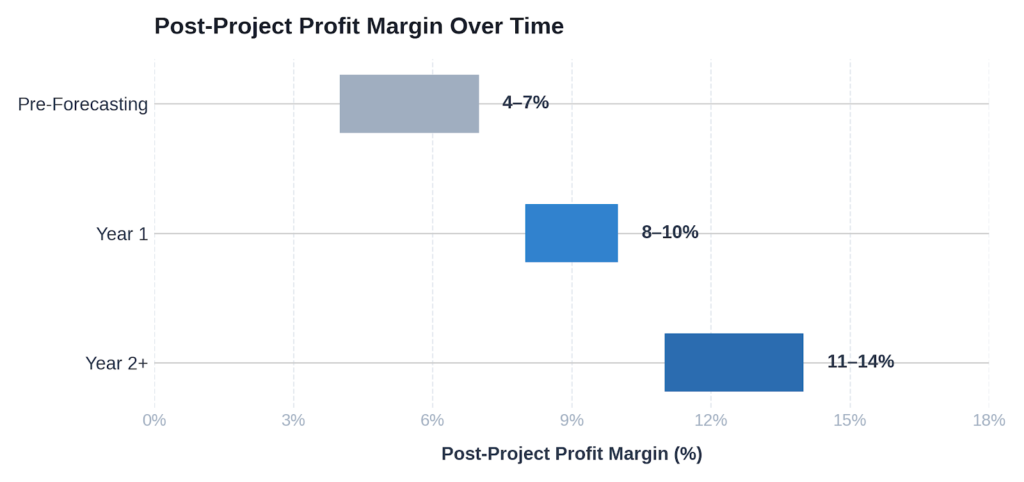
Above figures prove a fundamental business truth: firms who put work into forecasting accuracy win more business and retain more profit from what they win.
Syncing Forecasts Between the Structure and Finish Trades
Electrical forecasting cannot exist in isolation; accurately bidding the electrical portion of any project is now often predicated on lining up the electrical schedule and forecast with similar data from the other trades that operate concurrently on the same site. While an Electrical forecast has an ordering sequence dictated by design and installation logic, other forces will shape that order, like the schedule driven by framing. So whether rough-in starts tomorrow or later, the Labor and Cost estimate depends heavily on knowing that answer from the Framing Estimate.
The common requirement from many GCs is that both the FRAMING ESTIMATING SERVICES group as well as the Electrical Estimators exchange their estimating data as early in preconstruction as possible so their sequencing plans coincide and a forecast of one trade is not based on outdated or contradictory trade schedule assumptions. In the dynamic world of construction, accurate framing cost estimation and material takeoff services and House Framing Estimator are critical for the success of any project.
This is another instance of two or more sets of estimates sharing data, or in this case, sequencing assumptions, which will decrease the risk of mistakes coming not from bad data, but from non-correlated data.

Key Takeaways
- TheElectrical forecastrelies on reliable schedule inputs from the other Trades.
- Framing schedule has a direct impact onrough-inLabor estimations.
- Sharing of trade estimating information is key to a synchronized schedule.
- Collaborative, integrated estimating services are becoming a standard in the industry.
Read more: What are the Standard Picnic Table Dimensions in 2026?
Final Thought
From an electrical bidding standpoint, the use of data to forecast demand has transformed the process from one in which bidding came from instinct into a practice of understanding trends, utilizing modeling techniques, and encouraging inter-company teamwork. Whether for a small firm or a large one, all the evidence supports forecasting’s ability to shrink variance and increase success. Bid preparation based upon tradition may still be dominant within the contracting community, but as a viable approach to achieving an even better competitive advantage and better profit, the change to data-driven electricity forecasts is likely the single greatest improvement contractors can pursue today. By incorporating bidding into the normal preparation process instead of simply as an add-on, construction firms of any size will place themselves in a solid position for winning bids in tomorrow’s construction boom.
Frequently Asked Questions
Q1: How do Data-driven forecasting tools prove more reliable than standard bid methods? A: Predictions are made by statistical formulas derived from past cost history rather than a lone analyst, resulting in smaller forecast variances and more predictable future costs.
Q2: Can this work for the smaller contractor firm? A: Yes. Firms have success by partnering with specific bidding providers that offer technology to the smaller bid provider without the overhead burden of building a modeling and data acquisition team internally.
Q3: Will my estimator still be necessary if I install this software? A: No estimator will replace human experts. Humans and computer systems work together to test and prevent anomaly errors caught and evaluated on the fly by an actual person.
Q4: How long is it typically before a firm sees profit, win, and margin benefit? A: Most firms find some benefit to profit margin and win rate within their first year and then see a compounded effect as both the data’s accuracy and internal forecasting processes mature.
Q5: Why is cross-trade estimating a necessity for electrical estimating? A: The framing trades work ahead of the electrician, and cross-trade understanding will avoid incorrect assumptions being built into a forecast due to faulty timeline analysis.
