
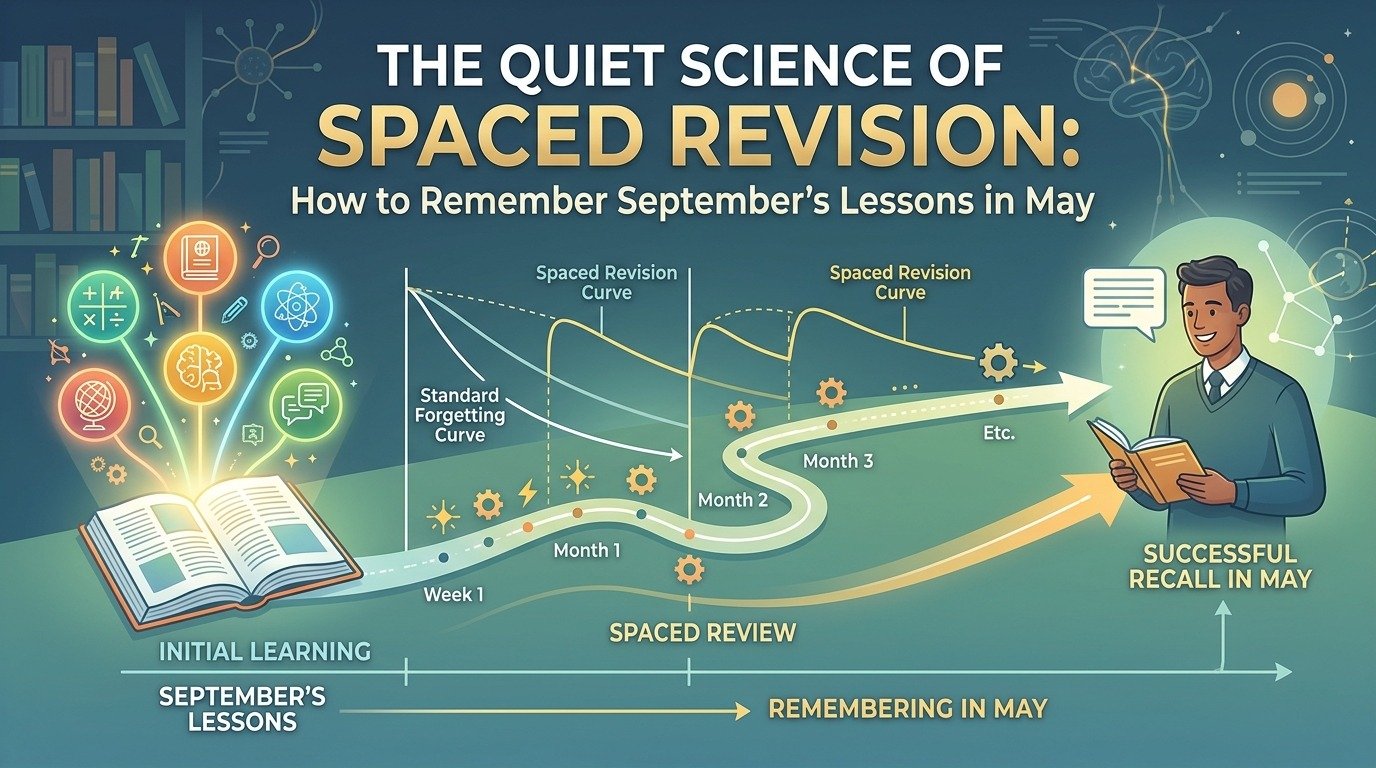
Every student knows the feeling. You studied a topic carefully in autumn, understood it well, even felt proud of your notes. Then the exam hall arrives in spring, and the details have thinned out like mist. This is not a sign of a weak memory. It is simply how human memory behaves when information is learned once and never revisited.
The good news is that forgetting follows a predictable pattern, and predictable patterns can be managed. Researchers have described the “forgetting curve” for well over a century: we lose a large share of new information within days unless we return to it. Spaced revision is the practical answer. Instead of cramming a topic into one long session, you meet it several times at widening intervals. If you are working through A-Level Past Papers, you will notice that examiners deliberately revisit the same ideas year after year, which makes spaced practice especially rewarding.
What spacing actually means
Spacing does not mean studying more. It means distributing the same hours differently. Imagine you give a topic three hours in total. The cramming version puts all three hours into one Sunday. The spaced version gives it forty-five minutes on day one, thirty minutes three days later, thirty minutes a week after that, and the remainder over the following month. The total is similar, but the second schedule asks your brain to retrieve the information repeatedly, and retrieval is what strengthens memory.
A simple rhythm many students find manageable is the 1-3-7-21 pattern. Review a topic one day after learning it, then three days later, then seven days later, then twenty-one days later. You do not need an app, although apps can help. A paper calendar with small tick boxes works perfectly well.
Retrieval beats rereading
Rereading feels productive because the material looks familiar. Familiarity, however, is not the same as recall. When you reread, you recognise; in the exam, you must produce. The most reliable way to bridge that gap is to close the book and try to write down everything you remember about a topic before checking your notes.
This is where practising with real questions becomes so valuable. A question forces you to retrieve, apply, and organise knowledge in one step. Rather than finishing an entire chapter first, try attempting a handful of questions on that chapter a few days after you learned it. You will discover gaps early, when they are cheap to fix, rather than in the final fortnight when time is short.
Building a spaced plan around your subjects
Start by listing every topic in each syllabus. Next to each topic, write the date you first studied it. Then schedule the next three reviews. This takes perhaps an hour at the start of term, and it saves far more than that later.
You can also mix subjects within a single evening. Studying two or three subjects in short blocks, an approach sometimes called interleaving, helps your brain practise choosing the right method for the right problem. This matters in subjects like mathematics and physics, where half the difficulty is recognising which formula a question wants.
Here is a sample weekly layout for a student taking three subjects:
- Monday: new material in Subject A (40 minutes), review of last week’s Subject B topic (20 minutes)
- Tuesday: new material in Subject B, short recall quiz on Subject C
- Wednesday: new material in Subject C, review Subject A from Monday
- Thursday: mixed practice questions from all three subjects
- Friday: light review and error correction
- Weekend: one longer timed paper, then a calm review of mistakes
Using error logs to guide the next review
Spaced revision becomes far more powerful when it is targeted. Keep an error log: a simple notebook where you record every question you got wrong, why you got it wrong, and what the correct approach looks like. Was it a knowledge gap, a careless slip, or a misread command word? Over a few weeks, patterns appear. Maybe you consistently lose marks on units, or you forget to link your answer back to the question in essay-style responses.
Your error log then decides what to review next. Topics that keep appearing in the log move to the front of the queue. Topics you answer correctly three times in a row can be spaced further apart. This keeps your time focused on the material that genuinely needs it.
Making it sustainable
The best revision plan is the one you can follow on a tired Wednesday evening. Keep sessions short, between twenty-five and fifty minutes, with proper breaks. Sleep matters more than most students admit, because memory consolidation happens overnight. A student who sleeps well and reviews briefly will usually outperform one who stays up late rereading.
It also helps to make resources easy to reach. If you have to hunt for a paper or a mark scheme every time you sit down, you will lose momentum. Having everything organised by subject and year on a site like QualifiedQuest.com removes that friction, so the only decision left is which topic to practise.
A final thought
Spaced revision rewards patience. In the first two weeks it can feel slower than cramming, because you keep returning to material you thought you had finished. By the second month the difference is obvious: topics that once slipped away now come back quickly and confidently. When exam season arrives, you will not be learning anything for the first time. You will simply be recalling what you have already practised many times, and that is the calmest place a candidate can be.
Start small. Choose one topic you studied this week, write the next three review dates in your calendar, and treat them like appointments. Your future self, sitting in the exam hall in May, will be grateful.
