
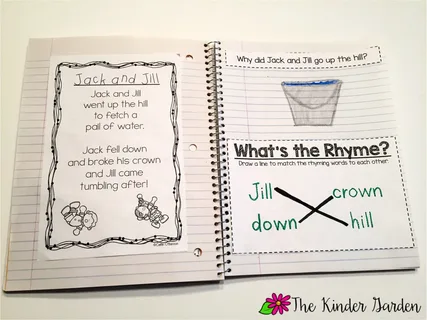
Nursery rhymes may seem simple, but their predictable rhythm, repeated phrases, rhyming words, and memorable patterns give young children valuable opportunities to explore language. As children become familiar with different sounds and word patterns, a nursery rhymes book can make these early language experiences more engaging through songs, repetition, and playful storytelling. Before they begin reading independently, children can gradually develop greater awareness of sounds, words, sentences, and the natural rhythm of spoken language through enjoyable shared reading with adults.
1. The Hidden Literacy Learning Inside Nursery Rhymes
Nursery rhymes provide children with repeated exposure to language in a format that is easy to remember. The combination of rhythm, rhyme, repetition, and short phrases makes many rhymes naturally suitable for young learners who are still developing listening and speaking skills.
A child may not be consciously thinking about literacy while reciting a rhyme, but they are noticing how words sound, where phrases begin and end, and how certain words relate to one another. These early observations can support later reading development.
Literacy Begins Before Independent Reading
Early literacy includes much more than recognising letters. Children gradually develop skills such as:
- Listening carefully to spoken language
- Understanding and using vocabulary
- Recognising sound patterns
- Remembering sequences
- Understanding that print represents language
- Communicating ideas clearly
- Noticing similarities and differences between words
Nursery rhymes can provide opportunities to develop several of these abilities within one familiar activity.
Familiarity Creates Opportunities for Participation
When children hear the same rhyme repeatedly, they often begin to anticipate words or phrases. An adult can pause before a familiar word and allow the child to complete it.
This simple interaction encourages children to listen actively. Instead of only receiving language, they begin predicting and producing it.
2. How Rhythm Helps Children Notice Language Patterns
Rhythm gives spoken language a noticeable structure. Children can clap, tap, move, or speak along with a rhyme, helping them experience differences in syllables, word lengths, and repeated patterns.
This rhythmic structure can make language easier to remember. A child may remember a complete line because the words follow a familiar beat, even before understanding every individual word.
Turn Rhythm Into a Physical Experience
Adults can encourage children to:
- Clap along with each phrase.
- Tap gently when a repeated word appears.
- Move like a character in the rhyme.
- Pause at the end of a line.
- Repeat a short phrase together.
The activity does not need to become a formal lesson. The physical response simply gives children another way to experience the structure of spoken language.
Notice the Beginning and Ending of Phrases
As children become familiar with a rhyme, adults can draw attention to where a phrase starts and finishes. This can help children become more aware of how continuous speech is divided into meaningful parts.
That awareness becomes useful later when children encounter written sentences and learn that spaces and punctuation help organise written language.
3. Why Rhyming Words Matter Before Formal Reading
Rhyming is one of the most noticeable features of many nursery rhymes. Words that share similar ending sounds give children an opportunity to compare how words sound.
For example, when children hear two familiar words that rhyme, they can begin to recognise a sound relationship even if they cannot yet identify the letters responsible for it.
Encourage Sound Comparison
Adults can ask simple questions such as:
- “Do these two words sound alike at the end?”
- “Which word rhymes with cat?”
- “Can you think of another word that sounds like light?”
- “Which two words in the rhyme sound similar?”
The aim is to develop listening and sound awareness rather than expect children to produce perfect answers every time.
Use Familiar Words First
Children are more likely to participate confidently when the vocabulary is already familiar. Once they understand the concept of rhyming, adults can introduce playful examples using new words.
Nonsense words can occasionally be useful for sound play, too. For instance, children can decide whether a made-up word sounds as though it belongs in a rhyming group. This focuses attention on sound rather than meaning.
4. Building Vocabulary Through Repeated Story Language
Nursery rhymes often contain words that children may not hear during ordinary conversation. These can include descriptive words, action words, objects, places, and expressions.
Repeated exposure gives adults opportunities to explain unfamiliar vocabulary without interrupting the entire rhyme.
Introduce Words Through Context
If a child encounters an unfamiliar word, the adult can first use the surrounding story or action to explain its meaning.
For example:
- Show a picture representing the word.
- Act out the word where possible.
- Connect it with something familiar.
- Use the word in another simple sentence.
- Ask the child to identify it later.
This helps children understand vocabulary through context instead of memorising isolated definitions.
Reuse New Words Naturally
Vocabulary becomes more useful when children encounter it again. A new word from a rhyme can appear later during play, drawing, conversation, or another story.
For example, if a rhyme introduces a particular animal or action, parents can refer to it during everyday conversation. The repeated exposure gives children additional opportunities to understand and use the word.
5. Strengthening Listening and Memory Through Recitation
Reciting nursery rhymes requires children to listen carefully and remember sequences of words. The predictable structure can make this challenging but achievable.
As children become familiar with a rhyme, they may remember complete lines, repeated phrases, or the order in which events occur.
Build Memory Gradually
Adults can use several simple approaches:
- Recite the first line and let the child complete the next phrase.
- Leave out one familiar word.
- Ask what happens next.
- Rearrange picture cards from the rhyme.
- Invite the child to act out events in sequence.
These activities encourage children to retrieve language rather than simply hear it.
Memory Supports Language Organisation
Remembering a sequence also helps children understand that language carries information in an order. This becomes important when they later read sentences, follow written instructions, retell stories, or describe events.
The objective is not to make children memorise large amounts of text. Short, enjoyable repetition is enough to provide useful practice.
6. Connecting Spoken Words With Printed Words
One important step in early literacy is helping children understand that spoken language can be represented through print. Nursery rhymes provide a familiar bridge between the two.
Once children know a rhyme by heart, adults can read the printed version while saying the words aloud. The child already understands the spoken sequence, so attention can gradually shift toward the marks on the page.
Point to Words During Shared Reading
An adult can occasionally point to words while reading. This helps children notice that:
- Print carries meaning.
- Words are arranged in a sequence.
- A sentence contains separate words.
- Written language follows a direction.
- Repeated spoken phrases can appear repeatedly in print.
The activity should remain relaxed. Preschool children do not need to identify every word independently.
Use Repeated Lines as Print Clues
If the same line appears more than once, children may begin recognising its visual pattern. Adults can ask them to find the repeated line on another page.
This provides an early opportunity to connect memory, spoken language, and printed text.
7. Encouraging Children to Predict What Comes Next
Prediction is a valuable language skill because it encourages children to listen for clues and use what they already know.
Nursery rhymes are particularly suitable because many have predictable sequences or repeated phrases. Once children become familiar with a rhyme, adults can pause before an expected word or action.
Make Prediction Interactive
Instead of immediately supplying the answer, ask:
“What do you think comes next?”
Children can respond by:
- Saying a word
- Pointing to a picture
- Completing a familiar line
- Choosing between two possibilities
- Acting out the expected action
The adult can then continue the rhyme and see whether the prediction matches.
Prediction Supports Comprehension
Although nursery rhymes are short, prediction introduces an important reading behaviour. Later, children will use information from words, pictures, sentence structure, and context to anticipate meaning while reading stories.
The skill begins with simple spoken-language experiences.
8. Using Actions to Deepen Language Understanding
Movement can help children connect words with meaning. When a rhyme includes an action, children can physically demonstrate what is happening.
For example, a child might jump, clap, walk, pretend to sleep, or imitate an animal. The action gives the spoken word a concrete reference.
Combine Movement and Vocabulary
Adults can choose a few important words from a rhyme and connect each one with an action.
| Rhyming Feature | Child Experience | Literacy Connection | Example |
| Repeated phrase | Says the phrase with an action | Builds language recall | Repeat a familiar line |
| Rhyming pair | Identifies similar ending sounds | Develops sound awareness | Cat and hat |
| Action word | Performs the action | Connects vocabulary with meaning | Jump |
| Character name | Identifies the character | Builds word recognition | Naming a character |
| Sequence | Acts out events in order | Supports narrative understanding | First, next, last |
This approach is particularly useful for children who enjoy movement and may find it easier to understand a new word when they can physically demonstrate it.
9. Turning Familiar Rhymes Into Early Reading Games
Once children know a rhyme well, adults can transform it into short language games. Familiarity means the child can focus on the new challenge instead of trying to remember the entire rhyme.
Missing-Word Games
Read a familiar line and pause before one important word. Give the child enough time to remember and complete it.
The missing word can later become more challenging. Adults might remove a rhyming word, an action word, or a character name.
Picture Matching
Create simple picture cards representing words from the rhyme. Children can match the picture to the word when appropriate for their level.
You can also ask children to group pictures according to:
- Rhyming sounds
- Characters
- Actions
- Objects
- Beginning sounds
Rhyme Sorting
Give children a small collection of familiar picture cards and ask them to identify which ones rhyme.
The focus should be on listening. Children do not need to read the written words for this activity to support early phonological awareness.
10. Moving From Shared Rhymes to Independent Language Use
The long-term value of nursery rhymes is not simply that children can recite them. Familiar rhymes can become starting points for children to use language creatively.
Once a child knows a rhyme, an adult can invite them to change one element. A character can visit a different place, an object can be replaced, or a new rhyming word can be introduced.
Encourage Simple Adaptations
For example, after learning a rhyme about an animal, ask:
“What would happen if the animal went to the park?”
The child can describe the new situation using familiar vocabulary. This moves the activity from memorisation toward communication and imagination.
Create New Rhyming Lines
Children can also experiment with making their own short lines. The result does not need to be grammatically perfect or technically sophisticated.
The important part is that children begin noticing how words can be selected because of their sound patterns. This develops language awareness while encouraging creativity.
11. How Parents Can Make Nursery Rhymes Part of Everyday Reading
Nursery rhymes do not need to be restricted to a particular lesson or scheduled activity. They can become part of ordinary family reading routines.
Nursery rhymes can easily become part of everyday family routines, whether a parent sings one before bedtime, during breakfast, or while travelling together. These short and repeated experiences help children become familiar with the sounds, rhythm, and vocabulary of spoken language.
To make these moments more engaging, parents can choose preschool books with bright illustrations, simple language, repetition, and activities that invite children to clap, repeat words, or join in with familiar lines. This keeps learning playful while encouraging children to participate actively.
The goal is to create enjoyable shared reading experiences. A child who associates books with conversation, play, rhythm, and discovery is receiving valuable preparation for later literacy.
12. Supporting the Transition From Listening to Reading
Nursery rhymes should not be expected to teach reading on their own. Early literacy develops through a combination of language experiences, phonological awareness, vocabulary, print exposure, conversation, and opportunities to explore books.
Rhymes can contribute an important part of this foundation because they make spoken language memorable and give children repeated opportunities to listen closely.
Adults can gradually build on these experiences by introducing letter-sound relationships, shared reading, storytelling, drawing, mark-making, and simple writing activities when children are ready.
Final Takeaway
Nursery rhymes offer far more than entertainment. Their rhythm, repetition, rhyme, vocabulary, and predictable structure can help children develop important early literacy foundations while keeping language learning enjoyable.
The most valuable approach is to use rhymes as a starting point for conversation, sound exploration, memory, prediction, movement, and shared reading. With carefully chosen resources, including suitable materials from Singapore Asia Publishers, parents and educators can create engaging literacy experiences that help children move naturally from enjoying spoken language toward understanding and exploring print.
Frequently Asked Questions
1. How do nursery rhymes support early literacy?
Nursery rhymes expose children to rhythm, rhyme, repeated vocabulary, sound patterns, and predictable language. These experiences can support phonological awareness, listening, memory, vocabulary, and early understanding of how language works.
2. When should parents start reading nursery rhymes with children?
Parents can introduce nursery rhymes during the early years and continue using them as children develop. Simple songs, rhymes, and shared reading can become part of everyday language experiences.
3. Can nursery rhymes help children recognise rhyming words?
Yes. Repeated exposure to rhyming patterns gives children opportunities to compare the sounds at the ends of words. Adults can make this more interactive by asking children to identify or suggest words that rhyme.
4. How can parents connect nursery rhymes with books?
Parents can read a familiar rhyme from a book while pointing to the printed words, discussing illustrations, identifying repeated phrases, and asking children to predict what comes next. This connects spoken language with print.
5. Should nursery rhymes be used only for phonics practice?
No. Nursery rhymes can support several areas of early literacy, including vocabulary, listening, memory, speaking, prediction, rhythm, sound awareness, and familiarity with printed language. They can therefore be part of a broader shared-reading routine.
