
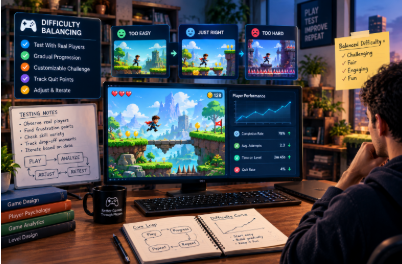
Difficulty is the single most contentious element of game design, because it directly determines whether a player feels challenged or frustrated, engaged or bored. Get difficulty wrong and even a mechanically sound game becomes unpleasant. Players quit not because the game is hard, but because it’s frustratingly hard, where difficulty feels arbitrary or unfair. They also quit when difficulty is too easy, where challenge disappears and engagement evaporates. Balancing difficulty means keeping players in that engagement zone where they’re challenged but not overwhelmed, where growth feels achievable and failure feels like feedback rather than punishment. That balance doesn’t happen by accident, it requires deliberate design choices, extensive testing, and willingness to adjust based on how real players actually respond.
Understanding What Difficulty Actually Is
Difficulty isn’t just about how hard something is mechanically, it’s about the relationship between player skill and the challenge presented. A task that’s perfectly balanced for an experienced player feels impossible for a newcomer, and trivially easy for an expert. That same task requires different difficulty levels for different players to feel appropriately challenging.
This is why the same game difficulty setting makes some players feel engaged while others feel frustrated. It’s not that the difficulty is objectively wrong, it’s that it doesn’t match that specific player’s skill level. Effective difficulty balancing acknowledges this reality and accommodates different skill levels without making anyone feel like they’re playing the wrong game.
Testing Difficulty With Real Players
Watch How Different Players Actually Perform
The most valuable difficulty data comes from watching real players, not from assuming or predicting based on mechanics alone. Different players interact with games in unexpected ways. A mechanic you designed assuming one approach might be solved through a completely different method. A challenge you thought would be difficult might be trivial. A section you assumed was simple might frustrate everyone.
Watching diverse players reveals these disparities. Watch a player attempt a challenge without helping or explaining. Note exactly where they struggle, where they succeed, how many attempts it takes, whether frustration shows or engagement shows. That observation is incomparably more valuable than reading difficulty descriptions or theories about how challenges should work.
Identify Your Actual Player Base
Difficulty balancing depends entirely on who you’re trying to reach. A game designed for experienced players has fundamentally different difficulty than a game designed for casual players. A game targeting speedrunners needs different challenge than one targeting story engagement. Understanding your actual player base, not the idealized version you imagined, determines what balanced difficulty actually means for your game.
This requires testing with people who represent your target audience, not just with friends or fellow game developers. A experienced player giving difficulty feedback won’t catch problems that frustrate newcomers. A casual player won’t identify whether experienced players find the game engaging. You need feedback from people representing different points on the skill spectrum.
Track Exactly Where Players Quit
When players quit a game, it’s not random. They quit at specific points where the game becomes frustratingly difficult, or boring and easy, or confusing about what they’re supposed to do. Identifying those quit points reveals exactly where difficulty is misbalanced. A consistent pattern of players quitting at the same section tells you that section has a difficulty problem.
Designing Difficulty Progression
Start Easy and Escalate Gradually
The beginning of a game sets expectations about how difficult the rest will be. If the opening is frustratingly hard, players assume the entire game will be unfair and quit. If the opening is trivially easy, players assume they’re playing the wrong difficulty setting or the game lacks challenge. That opening impression shapes whether players feel confident about continuing.
Effective difficulty progression starts with challenges new players can succeed at, builds confidence and understanding, then gradually introduces harder challenges. Each new section should feel slightly more difficult than the last, with progression building naturally rather than suddenly spiking.
Introduce New Mechanics At Appropriate Difficulty
New mechanics should be introduced at difficulty levels that let players practice them safely before relying on them in genuinely challenging situations. A player needs to understand how something works before being expected to master it under pressure. Introducing a mechanic in an easy section, having players practice it, then requiring mastery in a harder section, produces natural learning progression.
Avoid Sudden Difficulty Spikes
Consistent progression means each section is slightly harder than the last. Sudden spikes where difficulty jumps dramatically without warning frustrate players and make them question whether the game is designed fairly. If a section is significantly harder than everything before it, either it’s misbalanced or it needs clear communication that this section represents a new difficulty tier.
Providing Tools for Difficulty Customization
Offer Multiple Difficulty Settings
Different players need different difficulty levels. A difficulty setting for newcomers, one for experienced players, and one for veterans handles most of your player base. Each setting should feel appropriately challenging for that skill level without making other settings feel wrong. A newcomer setting shouldn’t feel patronizing. A veteran setting shouldn’t feel impossible.
Consider Dynamic Difficulty Adjustment
Rather than forcing players to choose difficulty upfront, dynamic difficulty watches how a player is performing and adjusts challenge level to maintain engagement. If a player is dominating, challenges get harder. If they’re struggling, challenges back off. That automatic calibration keeps players in the engagement zone without requiring manual difficulty setting.
Avoid Punishing Players For Their Choices
Difficulty should never feel arbitrary or unfair. When a player fails, they should understand why and feel like the challenge was fair. A boss with attack patterns that become learnable through observation feels fair. A boss that uses attacks nothing telegraphed feels cheap. The difference between legitimate challenge and frustrating unfairness matters enormously.
Communication About Difficulty
Be Clear About Difficulty Progression
Tell players what they should expect. “This section is about learning the mechanic” sets different expectations than “this section is the skill check.” That clarity helps players understand whether to keep trying or whether something isn’t clicking and they need guidance.
Provide Feedback About Performance
When a player fails, communicate why. What did they miss? What should they try next time? That feedback transforms failure from frustration into learning. A player who knows why they failed and what to try next feels challenged. A player who fails without understanding why feels frustrated.
Make Difficulty Settings Feel Legitimate
Each difficulty setting should feel intentional, not like a watered-down version of the “real” game. A newcomer setting should offer genuine engagement, not feel like training wheels. A veteran setting should offer genuine challenge, not feel artificial. That legitimacy means each setting has value and players don’t feel like they’re cheating by choosing lower difficulty.
A Practical Example of Balanced Difficulty
The Squid Gauntlet: Survival Trials demonstrates what balanced difficulty produces, a game where challenge feels fair and progression feels earned. The game shows how thoughtful difficulty design creates engagement where players feel engaged rather than frustrated.
Learning how to create a game with properly balanced difficulty means testing extensively with real players, watching exactly where they struggle, and adjusting based on observation rather than assumption.
Common Difficulty Mistakes
Games lose players through several recurring difficulty problems. Difficulty that scales too fast, overwhelming players before they’ve fully learned systems. Difficulty that doesn’t scale at all, where experienced players find nothing challenging. Difficulty that feels cheap or unfair, where players blame the game rather than blaming themselves. Difficulty that’s inconsistent, where some sections feel appropriately challenging while others feel arbitrarily hard or easy.
Why Difficulty Matters For Retention
Difficulty is often the first thing players abandon a game over. A game can have beautiful art, engaging story, innovative mechanics, but if difficulty is misbalanced, players quit before experiencing any of that. Conversely, a game with modest presentation but perfectly balanced difficulty keeps players engaged. That importance means difficulty deserves the same design attention as core mechanics or narrative.
Final Thoughts
Creating a game with balanced difficulty requires understanding that difficulty is relative to individual player skill, testing extensively with diverse real players, designing progression that escalates gradually while introducing new mechanics safely, providing difficulty options that feel legitimate, and communicating clearly about what players should expect. Watch where real players struggle, identify whether struggles indicate unfair design or appropriate challenge, and adjust based on observation. Balanced difficulty isn’t about making games easier or harder, it’s about creating challenges that feel fair and engaging regardless of player skill level. That balance keeps players engaged, builds confidence, and creates the sense that challenge is earned rather than arbitrary. The games that succeed long-term aren’t the flashiest or most complex, they’re the ones where difficulty feels appropriately calibrated, where challenge feels fair, and where progression feels achievable through skill and persistence.
